In the West, there is Thanksgiving—on this night, families cross state lines, tables laden with turkey and pies, to pause and express gratitude. In China, there is an older, grander, and equally sacred festival.
It is called Lunar New Year's Eve. And this night is not just about dinner, but a reunion dinner (the New Year's Eve feast).
For over a billion people, this meal is more important than any other meal of the year. It's not about culinary skills or rare ingredients, but about who sits at the table, who is absent, and who will be remembered. On this night, the entire nation—no matter how far they've traveled, how crowded the trains, how expensive the tickets—comes to a standstill and simply… goes home.
A dining table full of symbolism
Every dish on the family reunion dinner table carries meaning. It's not just a convenient menu, but a language of hope conveyed through food.
The fish (yú) must be served whole, head and tail intact. It symbolizes a bountiful harvest from the beginning to the end of the year. Cutting the fish signifies the continuation of good fortune. In many families, the fish is deliberately saved for the next day, symbolizing "abundance year after year."
The way dumplings (jiǎozi) are wrapped is not only for concealing the filling, but also to imitate the shape of ancient Chinese gold ingots. It symbolizes wealth, prosperity, and the expectation that the coming year will be better than the last. Some families still hide a clean coin inside a dumpling—the lucky person who finds it will receive blessings for the coming year.
Spring rolls (chūnjuǎn) are golden and crispy, shaped like gold bars. Rice cake (niángāo), this glutinous rice cake, symbolizes progress—"rising higher each year." Tangyuan (glutinous rice balls), soaked in warm syrup, symbolize family unity and completeness.
Every dish has its meaning. Every bite is a blessing.
However, behind every steamed fish, every golden and crispy dumpling, every piece of slow-cooked pork belly that crumbles at the slightest touch of chopsticks, there is something even more important—the utensils that bring these delicacies to life.
A family reunion dinner is a culinary marathon. It requires cookware capable of handling various cooking needs, from high-heat stir-frying to patient, long-term simmering. Sometimes, vegetables need to be quickly pan-fried to maintain their crispness; sometimes, a piece of pork belly requires sustained, consistent heat until it is completely tender and no longer chewy.
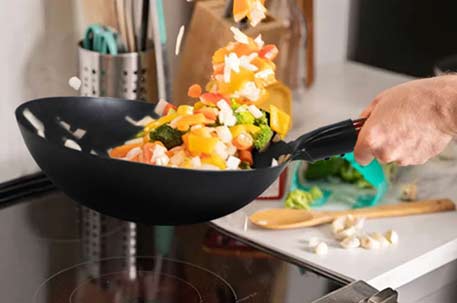
Heats up extremely quickly and reacts swiftly. A handful of greens hits the wok, and a sizzling sound echoes throughout the kitchen—the most honest cheer when food meets a hot wok. A quick toss, and the leaves arc through the air, landing back in the wok with a slightly charred aroma—this is the legendary "wok hei," the soul of Chinese stir-frying, a flavor magic that no Western frying pan can replicate. In the hands of a chef preparing a family reunion dinner, the wok is more than just a tool; it's an extension of culinary instinct.
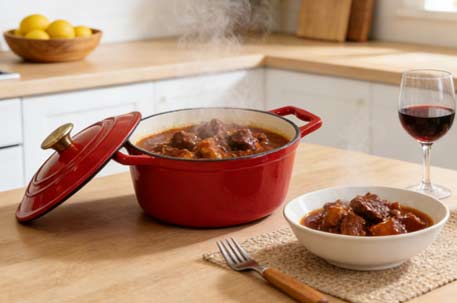
Slow cooking, long-lasting heat retention. The secret of the Dutch oven lies in its heat retention and circulation. Once the cast iron is fully heated, it releases energy steadily and continuously, unaffected by fluctuations in the stove's heat. The heavy lid traps every drop of steam, allowing it to condense and fall back onto the top of the pot, forming an inexhaustible "self-drenching system." It can cook braised pork belly, whole fish in rich broth, and other stews to perfection. The thick walls of the pot maintain their temperature for a long time after the flame goes out, ensuring that latecomers can enjoy their meals as if they were just served.
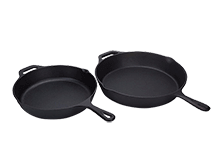
Long-lasting heat retention and excellent heat preservation. While carbon steel woks handle the rapid stir-frying and cast iron stew pots are perfect for slow simmering, the cast iron frying pan is the silent protagonist that creates the "golden moment."
For pan-fried dumplings that need a crispy bottom, its even and intense heat retention allows each dumpling to develop a perfect ice-flower pattern on its bottom; for pan-fried rice cakes that need a crispy exterior and chewy interior, its stable surface temperature gently caramelizes the sugar into an amber-colored crispy crust; for pan-fried fish that needs to remain intact without breaking the skin, its naturally formed oil film, cultivated over time, allows the fish to glide freely on the bottom of the pan, maintaining its perfect shape when it comes out.
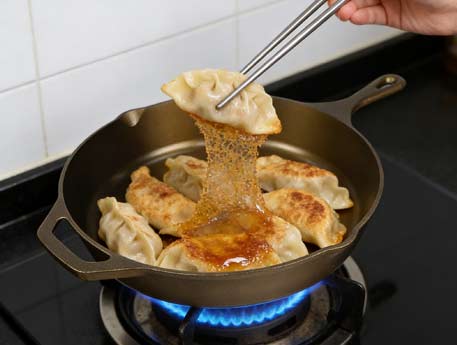
Every country has its own version of the family reunion dinner. Thanksgiving, Christmas, Easter—these meals transcend mere nutrition; they are tables that hold memories. But differences exist. While Thanksgiving turkeys in Maine and California are largely the same, the Chinese family reunion dinner is strongly regional. Sichuan families eat spicy hot pot; Cantonese families enjoy poached chicken and abalone; Northeastern families are laden with sumptuous stews. Though the dishes differ, the vessels for the feast remain constant. These utensils are not merely for cooking food; they also carry the memories of each reunion dinner.
What defines the reunion dinner is not the menu. It is the ritual of shared cooking, generations standing side-by-side around the stove, the recipe passed down not from books but through observation—a grandmother's hands guiding her grandchildren in learning to make dumplings.
Perhaps this is what a world increasingly disconnected from its own culinary traditions can learn from China's most important meal—the family reunion dinner:
Food cooked together nourishes not only the body but also the bonds between people.
A family reunion dinner is not just one meal, but thousands of meals spanning decades, cooked in the same pot and enjoyed at the same table. Even after the plates are cleared away, these memories linger.
This year, the reunion dinner table awaits your presence. Trains will slow down, and airports will empty. Chinese families around the world will gather around tables large and small. Fish will be served whole, and dumplings will be made by hand by young and old. In kitchens around the world, woks will sizzle, stew pots will bubble, and yet another reunion dinner will be etched into family history.
The reunion dinner is, and always will be, the most important meal of the year.
Because home is more than just a place.
No matter how far you've traveled, there's always a place reserved for you.
Happy Chinese New Year.
Copyright © Shijiazhuang Sarchi Trade Co., Ltd. All Rights Reserved. |
Sitemap | Powered by