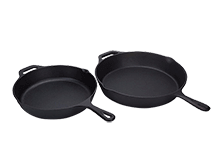
In recent years, as global consumer interest in healthy cooking and eco-friendly, coating-free cookware has surged, carbon steel pans—distinguished by their rapid heat conduction, high heat resistance, lightweight nature, and exceptional durability—are rapidly capturing market share previously held by traditional Teflon non-stick cookware.
However, as Sarchi—a cookware manufacturer with years of export experience—we firmly believe that demystifying the process of "seasoning and maintenance" is not only a prime opportunity to disseminate expert knowledge but also a critical factor in driving commercial success. Unlike treated cookware, raw carbon steel pans are not "ready to use" right out of the box; they require proper "seasoning" and routine maintenance to achieve their ultimate natural non-stick performance. If consumers handle them incorrectly, the pans are highly susceptible to rusting or food sticking—issues that directly inflate your rates of customer complaints and product returns. Once your customers gain a thorough understanding of the underlying "principles" and "methods" behind seasoning and maintenance, their satisfaction levels will soar, and their loyalty to your brand will deepen significantly.
To help you better empower your sales teams, refine your product documentation, and even make more informed decisions during the product selection process, we have compiled this comprehensive, professional guide to carbon steel pan seasoning and maintenance—presented from the unique perspective of manufacturing and materials science.
Before delving into the specific operational methods, we must first gain a thorough understanding of the fundamental nature of this phenomenon itself. People often simply describe the process of seasoning cookware as "forming a non-stick coating on the surface," yet this oversimplified characterization frequently fails to accurately capture the complex chemical reactions involved.
When explaining this to customers, do not simply say, "Apply a layer of oil." From a professional metallurgical and chemical perspective, the process of "seasoning" a pan actually refers to a "polymerization reaction" that occurs between cooking oils and the surface of carbon steel cookware. When we apply an extremely thin layer of cooking oil to a carbon steel surface and heat it beyond the oil's smoke point, the molecular structure of the liquid oil breaks down and then recombines to form a hard, smooth, and hydrophobic solid polymer film. This film not only acts as a barrier against air and moisture—thereby preventing rust—but also fills the microscopic pores on the carbon steel surface, resulting in superior physical non-stick properties.
1. Forms a Barrier—Establishes a protective layer between the metal and the food, preventing sticking caused by direct contact.
2. Prevents Oxidation (Rusting)—Protects by isolating the steel from moisture and air.
3. Improves Over Time—With each use, a microscopic film accumulates on the surface, gradually enhancing its performance.
4. Imparts Flavor—A properly seasoned pan adds a subtle yet rich depth of flavor to food.
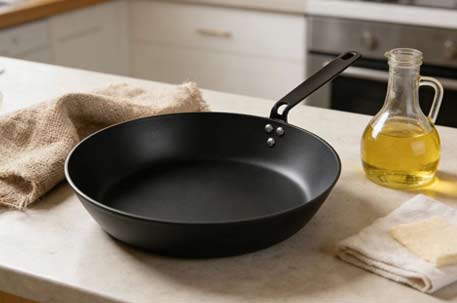
Step 1: Thoroughly Remove the Factory Protective Coating.
To prevent corrosion from salt spray during maritime shipping, bare cookware produced by reputable manufacturers is typically coated with a layer of food-grade anti-rust oil or beeswax. End users must thoroughly scrub both the interior and exterior of the cookware using hot water and dish soap until the surface feels dry and rough to the touch, with no remaining slippery sensation.
Step 2: Applying a Very Thin Layer of Oil.
We recommend using an oil with a high smoke point that is rich in polyunsaturated fatty acids, such as flaxseed oil, grapeseed oil, or canola oil. While the pan is still slightly warm, add a few drops of oil and use a paper towel to spread it evenly across the interior, exterior, and handle of the pan. It is essential to use a clean paper towel to wipe away all visible traces of oil, leaving behind only a faint sheen that is barely perceptible to the naked eye. Applying an oil layer that is too thick will result in a sticky surface and peeling after the seasoning process is complete.
Step 3: High-Temperature Polymerization.
Place the oiled pan on a stovetop over medium-high heat (or place it in an oven preheated to over 200°C/400°F) until white smoke begins to rise from the pan body. Maintain this smoking state for several minutes—until the smoke subsides—at which point the pan's surface will appear darker and take on a matte finish.
Step 4: Repeat the above steps.
Once cooled, repeat the "oil-wipe-heat-to-smoke" process 2 to 3 times; this will create a perfect, deep bronze-to-black non-stick surface.
"Seasoning" is not a one-time event; rather, it represents an evolving relationship between the user and the cookware that develops over time. Understanding this lifecycle will enable you to better guide your customers and help reduce long-term after-sales support costs.
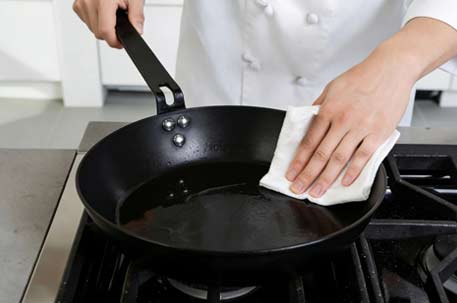
Comprehensive after-sales instructions can significantly reduce your customer service costs. Please be sure to remind your customers to adhere to the following "Three Dos and Three Don'ts" principles:
Must-Dos:
Clean While Hot: Immediately after cooking, while the pan retains residual heat, clean it using hot water and a sponge (the temperature difference helps quickly dislodge food residue).
Dry Thoroughly: After washing, be sure to place the pan back on the stove over low heat for 1–2 minutes to completely evaporate all moisture and prevent rust.
Apply a Thin Coat of Oil: Once dried, apply a single drop of oil to the interior surface for daily protection.
Absolute No-Nos:
Do Not Put in Dishwasher: The powerful water jets and harsh detergents will instantly destroy the polymerized oil seasoning you have worked so hard to build up.
Avoid Prolonged Cooking of Acidic Foods: Acidic ingredients—such as tomatoes, vinegar, and lemons—can dissolve the black polymerized oil layer, exposing the bare metal underneath (if this occurs, simply re-season the pan to restore it; carbon steel cookware is virtually indestructible!).
Never Run Cold Water Over a Hot Pan: The extreme thermal shock caused by rapid expansion and contraction can warp the bottom of the pan—this is a particular risk when using flat-bottomed pans on induction cooktops.
As a cookware manufacturer deeply rooted in the B2B export sector, Sarchi offers far more than just carbon steel cookware—we provide comprehensive commercial solutions:
Pre-seasoning Service: If you are concerned that your target audience may lack the patience required for the initial seasoning process, we can supply factory-pre-seasoned cookware, treated with high-temperature vegetable oil at our facility.
Nitride Treatment: Catering to the high-end market, we offer a specialized nitride anti-rust process. This treatment alters the surface structure of the carbon steel, endowing it with rust and corrosion resistance that far exceeds that of standard carbon steel.
Ceramic Non-stick Coating (PFAS-Free): We operate two production lines dedicated to non-stick coatings that fully comply with environmental protection standards. Furthermore, we offer a diverse range of non-stick coating options that can be customized to meet your specific requirements. We utilize high-quality, professionally certified, food-grade ceramic non-stick coatings that are highly scratch-resistant. These coatings are completely free of PFAS, ensuring a healthy and safe cooking experience.
Customized Manuals and Packaging: Leveraging our expertise in the areas mentioned above, we can provide OEM customization services to create illustrated seasoning and care manuals that are tailored to the reading habits and preferences of your local consumers.
A carbon steel pan is truly a "friend of time"—a well-maintained pan can easily be passed down from generation to generation. By equipping your customers with the correct knowledge regarding seasoning and maintenance, you are no longer simply selling a piece of cookware; you are offering a professional, healthy, and enduring lifestyle.
Are you ready to explore how we can leverage our expertise in carbon steel to enhance your product line comprehensively? We invite you to contact our B2B team to schedule a technical consultation or request samples for testing.
Copyright © Shijiazhuang Sarchi Trade Co., Ltd. All Rights Reserved. |
Sitemap | Powered by