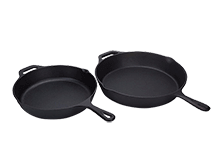
Sourdough continues to be one of the fastest-growing trends in the baking industry, with global online discussions surging by 79% year-over-year; notably, 70% of consumers believe sourdough enhances the flavor of baked goods. There is growing demand for "crispy textures and caramelized notes," and combining the distinctive tangy flavor of sourdough with other baking trends is generating significant market buzz.
For global cookware importers, premium baking equipment brands, and commercial kitchen equipment distributors, the artisanal sourdough craze is no longer a fleeting trend but a lucrative market segment. When expanding your commercial baking equipment product line, the choice between sourcing specialized enameled cast-iron bread ovens (featuring high-domed lids) and traditional enameled cast-iron Dutch ovens (deep, cylindrical vessels) will directly impact your market positioning, logistics costs, and profit margins.
This guide provides an in-depth analysis based on commercial viability, ergonomic design, and product line diversity, helping you determine which products to prioritize for your catalog.
Key Conclusions
- If you are targeting high profit margins, lower market competition, and strong social media sales potential—while aiming to attract the rapidly growing demographic of premium artisanal baking enthusiasts—choose the bread cloche. It represents a high-growth product opportunity for kitchenware companies specializing in the baking sector.
- If your core business relies on mass-market volume, budget-conscious household buyers, and versatile "all-in-one" sets, choose the Dutch oven. It remains a reliable, low-risk staple in any general kitchenware inventory.
To maximize business resilience, most successful cookware importers stock both product types and employ a tiered inventory strategy; this allows customers to choose based on their baking habits while enabling the business to capture both high sales volume and high-margin returns.
Technical and Specification Comparison
| Index | Professional Bread Oven | Traditional Dutch oven |
| Key design highlights | Designed specifically for sourdough bread | Multifunctional (soup, stew, braising, bread) |
| Ergonomic Safety | Excellent. The shallow design prevents burns during baking | Average. The deep sides increase the risk of wrist burns |
| Steam capture efficiency | Excellent. Low-profile dome concentrates steam | Good. Relies entirely on the weight of the flat lid |
| B2B profit potential | Higher. Positioned as a professional, specialized tool | Standard. Affected by intense price competition |
| Target end customers | Handmade bakers, small bakeries, gift markets | professional chefs, housewives, and hospitality professionals |
In-depth Procurement Analysis
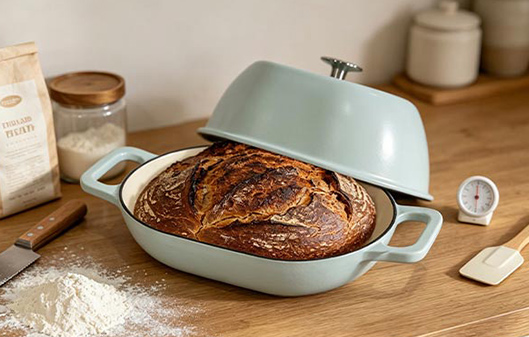
Enameled Cast Iron Bread Oven (Oval Cloche)
Specially designed for baking sourdough and artisan batards, this oven features a "shallow, wide base + high-arched lid" configuration and ergonomic side handles.
- The arched lid traps steam to create optimal, uniform moisture circulation within the pot, yielding a glossy, blistered, and crispy crust on high-hydration sourdough while maximizing "oven spring."
- The low-profile base eliminates the risk of burning the loaf's bottom, while the wide opening allows bakers to safely transfer scored dough into—and out of—the preheated cast iron vessel.
- The oval shape is perfectly suited for batards—the most popular bakery-style sourdough shape, offering strong retail appeal.
- Dual-purpose design: The arched lid can be flipped over to serve as a standalone skillet for frying eggs, cooking bacon, or making sandwiches, thereby enhancing the product's perceived value for the end user.
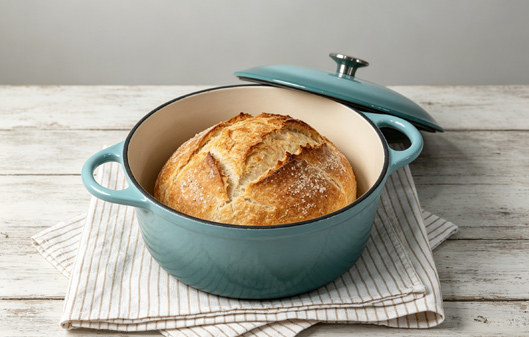
Traditional Enameled Cast Iron Dutch Oven
This is a versatile, deep, round pot with a flat lid; originally designed for stewing, braising, and making soups, it is also widely used for baking bread.
- The deep, straight sides effectively trap steam—ideal for baking round loaves (boules), but the narrow vertical space limits the rise of large, tall sourdough loaves.
- The deep body makes transferring hot, delicate dough risky; bakers often face the danger of burning their wrists when placing the dough into the hot pot.
- The round design accommodates only compact, round loaves, making it unsuitable for baking the elongated oval loaves (batards).
- Multi-functional: It combines stewing, poaching, deep-frying, and bread baking capabilities, appealing primarily to budget-conscious consumers looking to minimize their kitchenware collection.
Final Procurement Recommendation
When to choose a dedicated bread baking pan:
Private-label expansion: If you are a premium bakeware brand looking to capture the "sourdough enthusiast" market with a high-end product.
Commercial supply: If your primary customers include artisan baking schools, craft breweries serving house-made bread, or professional bakeware distributors.
When to choose a traditional Dutch oven:
Mass-market distribution: If you supply supermarket chains or department stores, and customers require a versatile, durable, and reliable "all-in-one" piece of cookware.
Hospitality and foodservice (B2B) channels: If you need to equip restaurant kitchens with cookware capable of handling tasks ranging from morning stews to baking simple loaves of bread.
As an OEM/ODM factory specializing in high-quality enameled cast iron cookware, Sarchi manufactures all its bread ovens and Dutch ovens using a heavy-duty enamel coating that offers exceptional thermal shock resistance. We offer enameled cast iron bread ovens and Dutch ovens in various sizes, providing comprehensive OEM/ODM customization, low-MOQ trial order options, and full compliance with FDA and LFGB standards.
Looking to expand your bakeware product line? Contact our sales team today to request free samples, wholesale price lists, and customized retail package solutions.
Copyright © Shijiazhuang Sarchi Trade Co., Ltd. All Rights Reserved. |
Sitemap | Powered by